

In 2026, the Monte-Carlo Television Festival celebrates its 65th anniversary
More than an anniversary, it is the story of a living institution, deeply intertwined with the evolution of television worldwide.
Created in 1961 by Prince Rainier III, the Festival was born from a clear ambition: to contribute to the development of television, elevate it, and promote it as one of the most powerful means of bringing people together and enriching cultures.
Very quickly, the event established itself as a major international rendezvous. Directors, producers, writers, and actors from around the world gather each year in the Principality to celebrate and shape this ever-evolving art form.
For 65 years, television has reflected societies and their transformations. Through it, the Festival observes, supports, and tells the story of the world.
This June, we are not celebrating an age, but a continuity, a vision, and a rare ability to navigate the revolutions of television without ever losing its soul.
On the occasion of this 65th edition, the Festival invites audiences to revisit its history decade by decade. A series of seven episodes…
Today: the 1960s, the decade that saw the birth of a global event destined to leave a lasting mark on television history.
When Prince Rainier III created the Monte-Carlo Television Festival in 1961, television was still a young medium, in the midst of invention.
In its early years, the Festival was held in winter, in January or February, depending on the edition. From its very first year, a jury composed of eminent personalities brought its authority, experience, and sense of fairness to nearly 63 works from 7 countries. The quality of the productions already demonstrated that television could rival cinema artistically.
Screenings took place in comfortable viewing boxes and, for the first time, jury members watched images broadcast in 625 lines, the definition of the future second channel of the RTF, thanks to the engineers of Télé Monte-Carlo. Technical innovation and passion for the medium were at the heart of these early years.
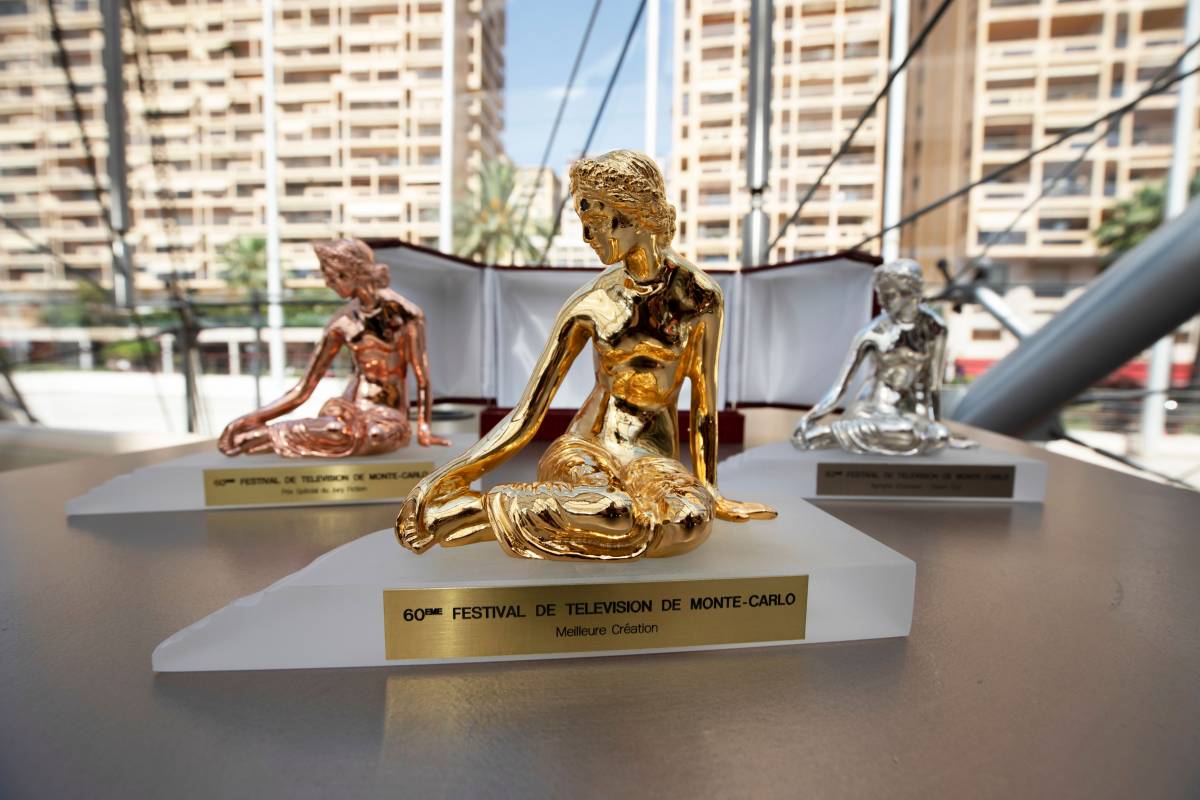
The Golden Nymph Awards Jury President was elected by peers: Marcel Pagnol, writer, playwright, filmmaker, and producer, presided over the first edition and remained loyal to the Festival for seven years. In 1962, Marcel Achard of the Académie française was elected President and declared: “If I were 20 years old, I would write for television – small dramas or small comedies. Television is the future!”
The Golden Nymph Competition quickly established itself as a success and rapidly expanded: fifteen countries were already represented, and nearly ninety programs competed in subsequent editions.
Monte-Carlo soon became a unique place where television professionals could compare their creations and observe the evolution of a rapidly transforming medium. Award-winning programs came from the United States, the Soviet Union, Japan, and Central Europe, proving that television, from its earliest days, transcended political boundaries.
Over the years, the Principality became the stage for a true artistic and media whirlwind. Film stars, leading television figures, and cultural journalists from around the world gathered to discover new creations and debate the future of the small screen. A Critics’ Prize, created in 1963, further highlighted recognition from the specialized press.
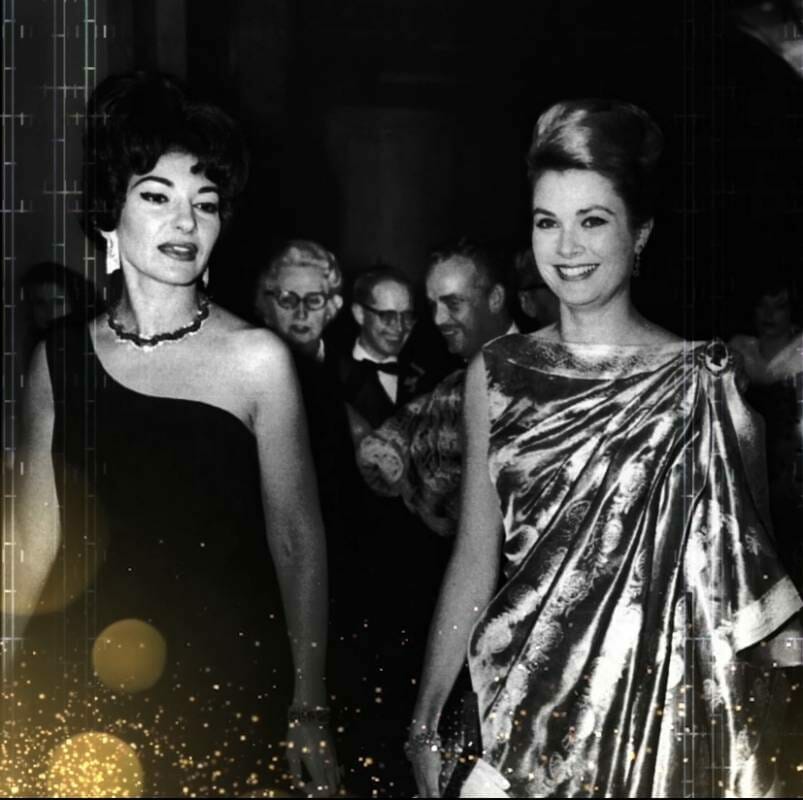
In Monte-Carlo, one could encounter Jane Fonda, Sophia Loren, Paul Newman, David Niven, Mike Connors, Gina Lollobrigida, Maria Callas, Roger Moore, Michèle Mercier, Martine Carol, Pierre Granier-Deferre, Line Renaud, Pierre Tchernia, René Goscinny, Jean Seberg, Charles Trenet, Romain Gary, Claudia Cardinale and Peter Ustinov, who chaired the Jury in 1966.
Journalists, critics, network executives, programming heads, and broadcasters from around the world also gathered in the Principality to discover new productions and discuss the future of this rapidly expanding medium.
The Festival also witnessed major technological transformations in television. In the mid-1960s, Monte-Carlo hosted one of the first public demonstrations of color television in Europe using the French SECAM system. Audiences and professionals discovered color images transmitted from Paris, heralding the television of tomorrow.
At the same time, the diversity of programs presented reflected the growing scale of television: drama films, documentaries, variety shows, children’s programs, reports and filmed live performances. With each edition, the Festival became a true global observatory of television creation.
By the end of the 1960s, the Festival was already recognized as a crossroads of global television. It fostered the circulation of ideas and talent, allowed technologically advanced countries to enrich others, and contributed to establishing television as a tool for information, education, and culture.
The decade concluded with a symbolic milestone: in 1969, the Golden Nymph Awards Ceremony at the Sporting Club, hosted by Guy Lux, was broadcast for the first time via Eurovision, marking the Festival’s entry into a new dimension, accompanied by the voice of singer and actress Marlene Dietrich, who closed the event.
A true showcase of television excellence, where the meeting of nations strengthens understanding and dialogue between people, the Monte-Carlo Television Festival had already become, less than ten years after its creation, one of the world’s leading television events.