


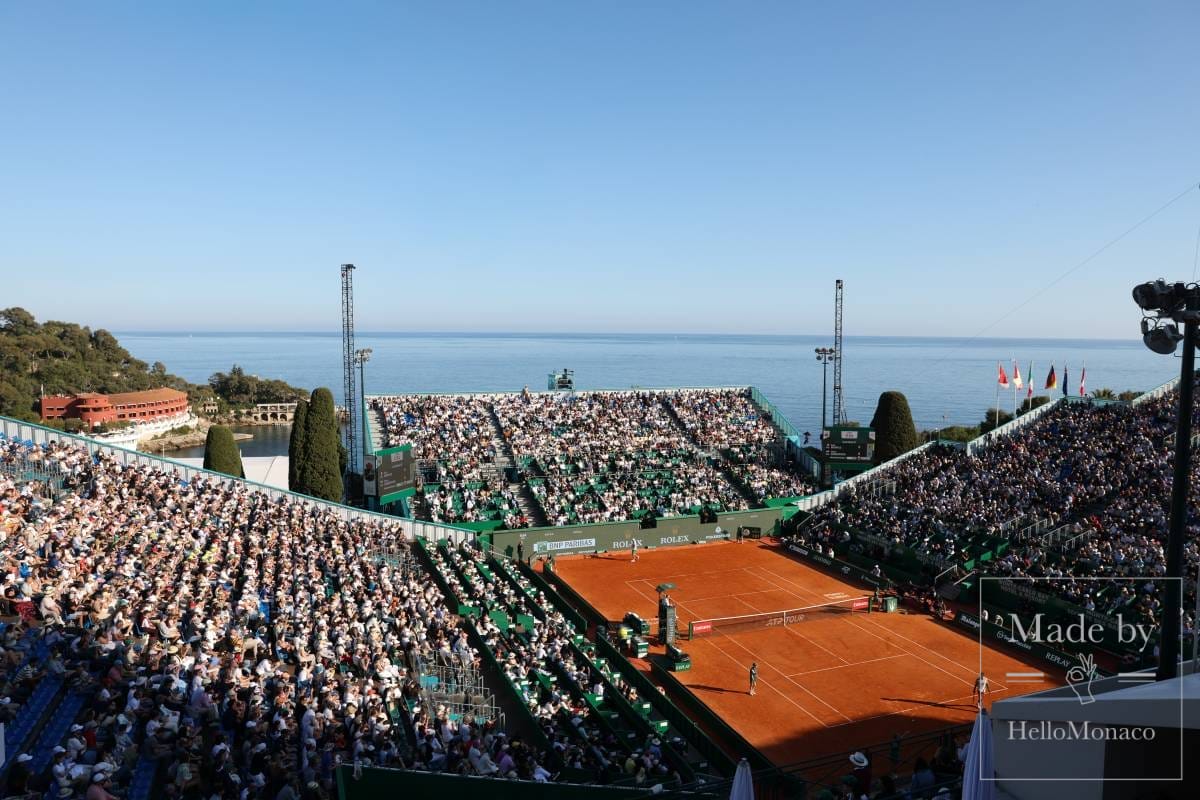


There are victories that belong to rankings. And then there are those that belong to history.
On a Monaco evening Valentin Vacherot did something the Principality has never seen before. Not in the long history of the Monte-Carlo Masters. Not in the era of champions who pass through.
He made it genuinely memorable and he made history.
The Match That Refused to Stay Linear
At first, it unfolded like a script already written. Vacherot four games up after Hurkacz’s serve drop early in the match. The crowd was already leaning forward, sensing something unusual. The outsider, Hubert Hurkacz, a top-tier name, a man accustomed to controlling tempo, slightly off rhythm.
But Monte-Carlo has always had a taste for disruption.
The wind shifted. The rallies lengthened. Precision gave way to tension. Hurkacz recalibrated, quietly, ruthlessly, five consecutive games. The first set slipped away from Vacherot in a tie-break, as if reminding everyone of hierarchy.
A Crowd That Was Not Just Spectating
This is where the story diverges from statistics. Because on the terraces of the Monte Carlo Country Club, the usual polite applause dissolved into something closer to collective will. They were not watching him. They were carrying him.
Friends. Former classmates. Federation juniors. A living echo chamber of memory and belonging. Vacherot later said, “they give you wings,”. Energy became oxygen.
The Second Set: A Reset of Reality
The second set did not explode, it tightened. Each service game held like a negotiation. Each rally edged closer to the kind of exchanges that define clay-court tennis . Then, almost imperceptibly, Vacherot struck: a break carved not from dominance, but from persistence.
The Third Set
If the first set belonged to structure, and the second to belief, the third belonged to character.
Hurkacz, at his elastic best, defended like a man possessed, slides, stretches, improbable retrievals. He turned defense into defiance.
But Vacherot, less explosive, less statistically imposing, became something else entirely: unmovable. Not in stance, but in intent.
The break came at 4–3, after a sequence of points that felt less like tennis and more like negotiation with gravity itself. And then, inevitably, the final game: serve for history, with the weight of a nation condensed into a rectangle of clay.
He held.
6-4.
After 2 hours and 53 minutes, Monaco had its moment.
A First, But Not Just a First
No Monégasque had ever reached the quarter-finals here. And he had previously beaten World ranked #5, Lorenzo Musetti , yet another formidable feat. Not in a tournament that has seen the elegance of Rafael Nadal, the precision of Novak Djokovic, or the new-generation electricity of Carlos Alcaraz.
This is not a minor statistical footnote.
This is a redefinition of what is possible for a player shaped within the Principality.
The Next Chapter: Speed vs Soul
Waiting ahead: Alex de Minaur. A different challenge entirely. Relentless pace. Elastic coverage. Tactical suffocation.
This now raises the question: Can Vacherot extend his winning streak.
Monaco as Protagonist
This week, something subtle has shifted.
The Principality is no longer just hosting excellence. It is producing it.
And this might not be an anomaly. It might be an extension of what already is historic!