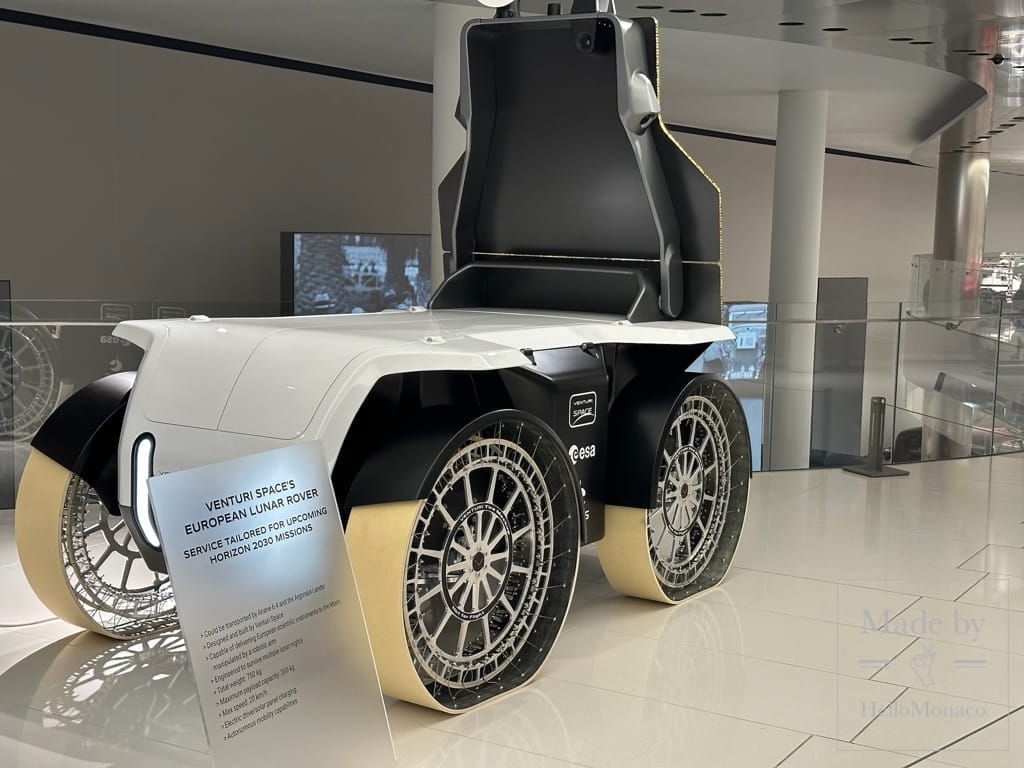


In the cavernous ESA–DLR LUNA hall in Cologne, where crushed rock mimics parts of the lunar surface, a machine conceived by the Monaco-based Venturi Space and developed across Monaco, Switzerland and France (Toulouse), recently did something deceptively simple: it drove forward.
The rover is called Mona Luna. The moment, its first successful roulages, is the visible proof of a long, deliberate ambition nurtured in the Principality: that Monaco, better known for motorsport and luxury, can also collaborate to shape Europe’s future on the Moon.
A Monegasque Vision, Executed in Collaborating Teams Across Europe
At the centre of the project stands Gildo Pastor, whose belief that Monaco should be a laboratory for advanced mobility has guided Venturi for over two decades. From electric racing to Antarctic exploration, Pastor’s strategy has been consistent: master extreme environments on Earth, then push beyond them.
Mona Luna is the clearest expression yet of that philosophy.
While Venturi Space operates across borders, the programme is unmistakably Monegasque in spirit. Engineering and systems development are shared between Venturi’s three principal sites including Monaco. Venturi’s French site contributes advanced space engineering and industrial integration. And their Swiss site is home to precision manufacturing and critical component development.
This tri-national collaboration is not incidental, it is foundational. It reflects a European model of space innovation executed through complementary centres of excellence.
Designing for the Moon Means Unlearning Earth
The rover itself weighs approximately 750 kg, expandable to up to a tonne depending on mission configuration. Yet numbers tell only part of the story.
The aesthetic of Mona Luna bears the imprint of Sacha Lakic, Venturi’s long-time design director. Lakic’s approach rejects the traditional separation between beauty and utility. On the Moon, form is function, and every curve, articulation and surface exists to solve a problem posed by dust, vacuum, or extreme temperature.
That philosophy extends to the rover’s most striking feature: its hyper-deformable wheels, capable of reshaping themselves as they encounter loose regolith, steep inclines or sharp obstacles. Watching them in motion during tests, engineers noted how the rover appears to “flow” over terrain that would immobilise conventional vehicles.
Engineering the Unforgiving
The rover’s resilience owes much to the work of Dr. Antonio Delfino, whose focus has been on ensuring survivability in the Moon’s most punishing conditions.
The rover is designed to endure repeated lunar nights, stretches of extreme cold that destroy unprotected systems, while remaining operational across long mission durations. Power management, thermal control, and redundancy are not secondary concerns; they are the mission.
During recent tests at the European Space Agency’s LUNA facility, Mona Luna demonstrated its ability to climb slopes exceeding 30 degrees, traverse uneven rock fields, and maintain stability where gravity offers little forgiveness. These tests were quiet confirmations that the engineering choices made in Monaco and refined across Europe were sound.
Building the Future at Scale
The success of Mona Luna comes as Venturi prepares for its next major step: the creation of a new, large-scale facility dedicated to advanced space mobility systems. This site, currently in development, will allow Venturi to consolidate testing, assembly and next-generation research under one roof, dramatically increasing its capacity to deliver complex space hardware.
For a company rooted in Monaco, this expansion is symbolic. It signals that Venturi’s ambitions are no longer limited to experimental prototypes, they are industrial, long-term, and international.
More Than a Rover
Mona Luna is not yet bound for the Moon. Its expected deployment is toward the end of the decade. But its role is already clear: it is a technological pathfinder, a platform on which future European lunar missions will be built.
For Monaco, the achievement resonates on another level. It demonstrates that the Principality’s contribution to global innovation need not be confined to finance, tourism or sport. Through Venturi, Monaco is exporting something rarer: credibility in extreme engineering.
As the rover rolled forward in Cologne, its wheels compressing simulated lunar dust, it carried with it more than sensors and circuits. It carried a distinctly Monegasque idea, that precision, ambition and imagination can travel far across Europe beyond the harbour.
Even as far as the Moon.