



Prince’s Day, November 19th, 2026! A day to cherish when Hereditary Prince Jacques and Princess Gabriella arrived to their first National Day Mass in the cab Princess Grace, their grandmother, brought to Monaco to take her own children to school. Later, a special feature on Palace Square were the Prince’s Carabiniers Orchestra marking their 60th anniversary. And in the evening the celebrations moved to the Grimaldi Forum for Gershwin’s Porgy and Bess. This and much more on a very special Monaco National Day 2026 with unique touches.
The car that drew up outside Monaco Cathedral on Thursday morning was a London taxi. The 1952 Austin FX3 normally sits on display in the Prince’s Car Collection. Princess Grace had it brought to Monaco to take her children to school. On 19 November 2026, it carried two of her grandchildren, Hereditary Prince Jacques and Princess Gabriella, to their first National Day Mass with Prince Albert II and Princess Charlène. The cab dates from the very year Monaco began celebrating National Day on the 19th November date in 1952.
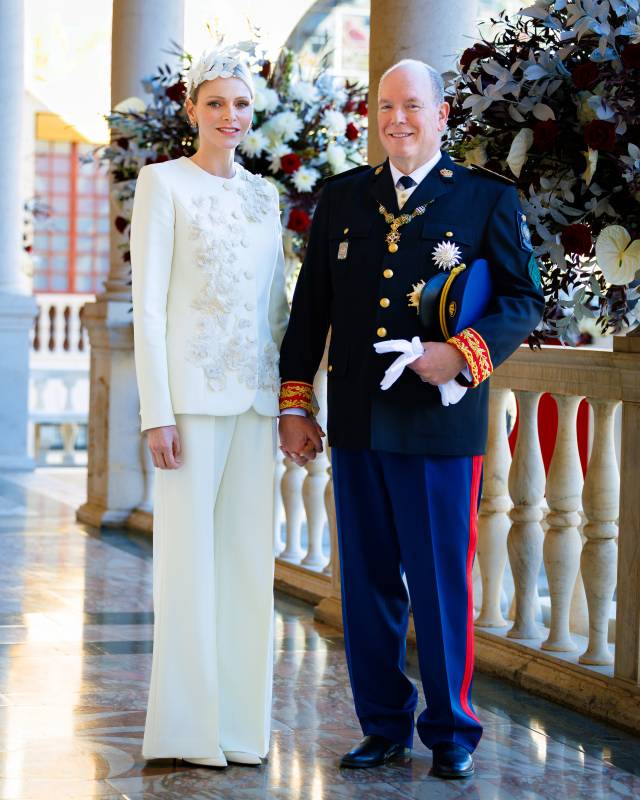
Jacques wore the dress uniform of the Prince’s Carabiniers, echoing his father’s military dress. Princess Charlène wore ivory with raised floral embroidery, echoed in Gabriella’s long coat dress. Flowers adorned elsewhere at the Cathedral. Tiny lilies of the valley were woven into Beatrice Borromeo’s powder-pink Dior suit, while oversized blooms trimmed Charlotte Casiraghi’s black dress.
Archbishop Dominique-Marie David led the Mass of thanksgiving and Te Deum. The service opened with a message from Pope Leo XIV, who sent his blessing to the Princely Family and the people of Monaco. In his homily, the Archbishop recalled the Pope’s visit to the Principality on 28 March and invited the congregation to pray for wisdom and discernment for the Sovereign. Prince Albert’s sisters, Princess Caroline and Princess Stéphanie, sat behind the Princely Couple and their children. Among those attending were Andrea Casiraghi and Tatiana Santo Domingo, Charlotte Casiraghi, Pierre Casiraghi and Beatrice Borromeo, Louis and Marie Ducruet, and Camille Gottlieb.
A salute, a drumroll and a cheer
Back at the Palace, Prince Albert raised a white-gloved hand in salute as the Monégasque anthem was sung “a cappella” in the Court of Honour. Hereditary Prince Jacques stood beside him in uniform, mirroring with precision his father’s salute. The Sovereign reviewed the troops and presented rank insignia to 41 members of the Force Publique who had been promoted during the year. A Carabinier and a firefighter received the insignia of Knight of the Order of Saint Charles. And six Palace staff members also received medals.
More of the younger generation came into view in the courtyard. Andrea and Tatiana were joined by their three children Sacha, India and Maximilian. Charlotte attended with her sons Raphaël Elmaleh and Balthazar Rassam, and Pierre and Beatrice with their sons Stefano and Francesco. Monaco is well acquainted with a défilé. On Prince’s Day, the runway was the Place du Palais. Medals flashed in the November sunshine and red-and-white plumes stood out against the blue sky. From the central Palace balcony, Prince Albert and Princess Charlène watched with Jacques and Gabriella, while relatives looked on from the balconies to either side.
The Prince’s Carabiniers Orchestra marked its 60th anniversary by retracing its growth from a small military band. The tribute began with a lone timpanist. Later, a piper played the opening of Amazing Grace before the orchestra joined in. Dancers from La Palladienne performed to traditional Monegasque tunes, and before the final honours the musicians and a detachment of Carabiniers formed the number 60 in the square.
A few thousand people had gathered in Palace square. After the parade, spectators moved forward beneath the Palace windows, waving flags. “Prince Albert, hourra!” rang out, followed by cheers for Princess Charlène. The family waved back. The scene had an echo in the same square 165 years earlier. In 1861, as HelloMonaco Magazine recounts, townspeople raised a triumphal arch for Charles III and cheered as his carriage passed beneath it.
Gold over the harbour and at the opera
On the eve of Prince’s Day, fireworks lit up Port Hercule. Gold bursts silhouetted the yachts and send light rippling across the water. The spectacle in 1876 had been up in Casino Square, where some 25,000 red and white lights flared into life together. The pyrotechnist Ruggieri had even sent a salamander chasing a butterfly, with the Philharmonic Society supplying the music.
This year’s public programme also brought a new invitation from the Town Hall for children to make a shared picture of Monaco on the Place de la Mairie. Down at the Condamine Market, tastings of local specialities gave way at lunchtime to a giant stocafi, the traditional stockfish dish. The red-and-white plumes were back after dark. A line of uniformed guards stood to attention at the Grimaldi Forum as Prince Albert II, Princess Charlène and Princess Caroline arrived for the Opéra de Monte-Carlo’s new production of Porgy and Bess. Charlène wore a red-and-white sash over a long-sleeved gown with gold and silver sequins, reported as adapted from a Elie Saab couture design. The day had begun with a London cab pulling up on the Rock. It ended in Gershwin’s Charleston. The last notes of Gershwin faded, but the affection for Monaco and its Sovereign had already found its voice that morning in Palace Square. On 19 November 2027, and on every Prince’s Day thereafter, the red and white will rise again. Flags will wave together beneath the Palace windows, and the old cries will ring out across the Rock. “Prince Albert, hourra!” And in Monégasque, “Viva Mùnegu!”
Historical inset | How 19 November became Prince’s Day
Monaco’s National Day is also known as La Fête du Prince, or Prince’s Day. For much of its history, a change of sovereign could mean a change of date for Prince’s Day. Charles III, who came to the throne 170 years ago, chose 4 November, the feast of his patron saint, Charles Borromeo, for his accession ceremonies in 1856. Monaco began celebrating the sovereign annually on that date in 1857.
Prince Albert I moved the celebration to 15 November, Saint Albert’s Day, in 1890. Louis II’s own saint’s day fell in August, during the summer holidays. In 1922 he chose 17 January, the feast of Saint Anthony the Great, patron saint of his granddaughter Princess Antoinette.
Under Prince Rainier III, the holiday was observed on 11 April in 1950 and 1951. It moved to 19 November in 1952, marking the anniversary of Rainier’s 1949 accession ceremony and the day chosen to honour his patron, Rainier d’Arezzo. When Prince Albert II succeeded his father in 2005, he kept 19 November as a tribute to him. It was also the date of Prince Albert’s own enthronement.
The celebrations under Charles III already brought together worship, military ceremony and public festivities. As HelloMonaco recounts in the latest issue of the Magazine, the 1876 Te Deum took place in the Chapel of the Visitation while the new Cathedral was being built. There was an inspection of the troops and a parade, then pole climbing and sack races in Palace Square. Charles III even provided a chicken for every Monegasque. Today the Mass of thanksgiving and Te Deum begin the official day at the Cathedral, followed by honours at the Palace, the parade and the Princely Family’s balcony appearance. The eve fireworks and evening gala give the festivities their public opening and ceremonial close.