


In Monaco’s gaming rooms, a croupier’s hands have several jobs. Dealers handle cards, separate chips, and move stacks across the felt, while watching the people and bets around the table. The work joins dexterity with arithmetic and conversation. A visitor can follow a roulette result or a blackjack hand without noticing how much effort goes into keeping that game clear and orderly.
Indeed, the job is so important that there are international competitions run to determine how well dealers are performing, with winners ranked on things like concentration, precision, and table control required during ordinary play.
Following the whole table
Roulette and blackjack are games commonly examined in championships. They place different demands on a dealer. Roulette involves tracking bets across a marked layout, handling chips, and settling the round after the result. Blackjack adds the work of totaling separate hands, dealing additional cards, and following each player’s decisions. The dealer applies the rules while keeping track of the equipment, the bets, and the people taking part. Players can concentrate on their own bets or hands; the dealer follows the activity across the table, including each participant’s next action.
Clear movements help players follow a game from a seat at the table or through a camera. In human-dealt games on IgnitionCasino, physical cards and roulette wheels appear over a live video feed. The dealer’s visible actions mark the progress of the round, just as they do for someone watching a table in Monaco. A dealer is just as important in a live game at an online casino as they are on a physical floor; their role stabilizes the game, manages the players, and ensures play progresses smoothly. Good online casinos recognize the importance of this and prioritize their dealers for live games, maximizing the experience for everybody.
In Monaco’s gaming rooms, all those actions happen alongside the movement of chips between players and the dealer. A round has several stages, and the dealer’s work continues after the cards are revealed or the ball comes to rest. Bets must be settled and the table prepared before play moves on.
What happens in the hands
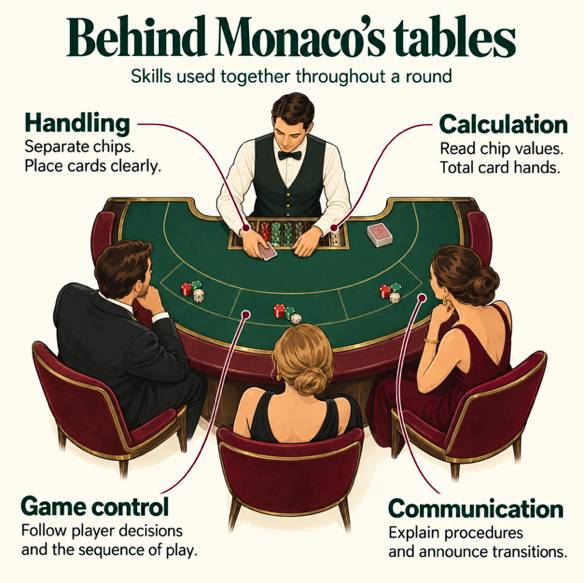
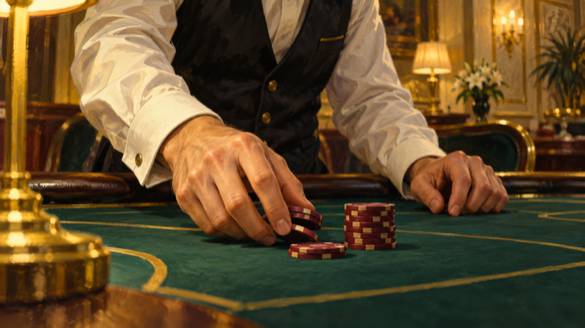
Cutting chips means separating chips from a stack with a controlled movement of the fingers. It is used when handling bets, making change, and checking amounts. Arranging chips in clear groups lets players, supervisors, and surveillance staff check the amount. A neat stack has a practical purpose: other people need to be able to read the transaction while it happens. Stack pushing presents another physical task: moving grouped chips across the table while keeping them together. Many dealer awards concern that physical control.
The arithmetic starts with reading chips: their number and denominations, or individual values. Counting a stack establishes how many chips are present; recognizing those values establishes the amount it represents. The dealer then applies the payment rules for the game.
Blackjack dealers also keep track of card totals as hands develop. Roulette requires calculations based on where bets sit on the layout and the corresponding payment rules. Dealer training treats these as practical arithmetic skills, learned alongside the handling of chips. A correct calculation still has to become a correctly assembled payment that others can follow.
Card placement is equally deliberate. In blackjack, keeping the hands distinct allows players and staff to follow the deal. Collecting the cards after the round also follows a procedure, preparing the table for the next hand. The exact movements vary with the game and the venue’s instructions, so there is no single dealing routine that covers every table.
Keeping the game understandable
In the 2026 European Dealer Championship, judges assessed speed and technical ability alongside precision, game control, presentation, and hospitality. The assessment extended to how a dealer managed the table and interacted with its players. Technical handling was one part of a performance that also included service.
Game control means keeping the stages of play in order. In blackjack, the dealer follows the progress of individual hands before settling the round. In roulette, players need to know when bets are being accepted and when betting has closed. Announcements give everyone a shared indication of what is happening, helping separate one stage of the game from the next.
Questions are part of that interaction. A dealer explaining a procedure needs to be clear about what the player should do, while remaining aware of the rest of the table. A courteous explanation and a correctly dealt hand draw on different abilities, but the job calls for both during the same round.
Learning Monaco’s games
Monaco’s training reflects that range. The local dealer academy teaches six games: blackjack, Texas Hold’em Ultimate Poker, English roulette, craps, Punto Banco, and European roulette. Training covers the games themselves, as well as the practical work of dealing them.
That curriculum spans cards, wheels, and dice. Learning to handle one set of equipment does not supply the procedures for another. Even within card games, the dealer must distinguish the rules governing the next card from a player’s available choices. The common foundations are accurate handling, arithmetic, and the ability to keep the game understandable.
Monaco’s championship results offer names and awards. At the table, the same profession is visible in smaller actions: a clearly separated stack, an accurate total, a card placed in sequence, and an announcement made at the right stage of play.