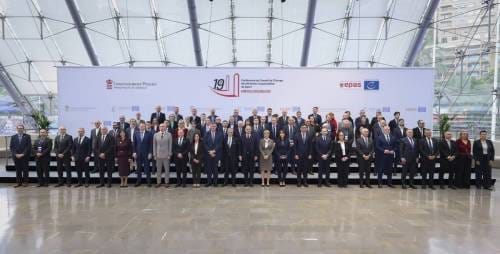





Monaco was among the first eight countries who signed a new treaty in Strasbourg that strengthens the capacity for authorities to confiscate assets, including crypto-assets, obtained through criminal conduct. The signing took place at the Palais de l’Europe on 14 October.
Monaco, Georgia, Greece, Hungary, Luxembourg, Montenegro, San Marino and the United Kingdom were the first of the 46 Council of Europe member states to sign the treaty, opened for signature on the occasion of the 2026 Octopus conference on cybercrime.
Modernizing the Warsaw Convention
The new treaty is an Additional Protocol to the Warsaw Convention (the Council of Europe’s Convention on money laundering, search, seizure and confiscation of criminal profits and on the financing of terrorism, adopted in 2005). It modernizes the legal and institutional frameworks for asset recovery, in response to increasingly sophisticated, transnational and technologically advanced criminal networks.
“Criminal money sustains organized crime. It also buys what should never be for sale: our democracies. Taking that money away is democratic security. No state can recover criminal assets across borders on its own. With this Protocol, none will have to,” said Alain Berset, Secretary General of the Council of Europe.
“Follow the Money”
According to a recent press release by the Council of Europe, the treaty introduces major new tools to “follow the money”. Courts will be able to confiscate property linked to wider criminal conduct, in some cases without a criminal conviction. Assets held by third parties can also be targeted, while “protecting good-faith holders”.
“Authorities will be able to freeze or seize assets urgently, where appropriate, without prior notice, before they can be moved or concealed. The protocol also requires states to establish offices that can trace and manage criminal assets. It strengthens the role of financial intelligence units and improves authorities’ access to financial and virtual-asset data,” says the press release by the Council of Europe.
Effective use of the tools provided by the protocol should make cross-border asset recovery faster and fairer. The protocol aims to strengthen international cooperation through broader information-sharing, and joint investigations. Cooperation between asset-recovery and asset-management offices should speed up response time to “within three days in urgent cases”.
Benefitting Communities
“Confiscated assets will be returned as a priority to victims or their legitimate owners, and confiscated sums above €10 000 will, as a rule, be shared equally between the countries involved. States are also encouraged to use confiscated assets for social or public benefit turning the proceeds of crime into a benefit for communities,” said the Council of Europe’s press release.