
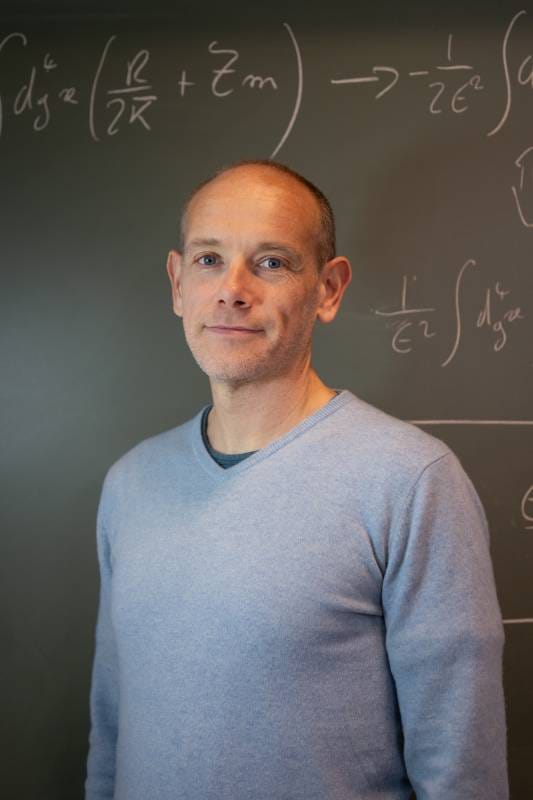


T-shirt and Bermuda shorts, youthful figure, smiling face. Looking like a tourist on the French Riviera. And yet… This man isn’t here for sunbathing. He remains glued to his screen, but once he looks up, it’s to travel all the way to the stars. We are dealing with an eminent astrophysicist here. Having “fallen”into a black hole back in his teenage years, he has since been pursuing the universe’s most unfathomable mysteries. A researcher at the Côte d’Azur Observatory, Olivier Minazzoli is also coordinator at the Monaco Space Affairs Office. A dual role for this Monegasque, a leading authority in general relativity studies. Putting the famous relativity theory through multiple tests, researching a brand new concept, he went as far as “rivalling” Einstein himself. His “entangled relativity theory” is demonstrating just how matter and spacetime cannot exist without each other.
Olivier Minazzoli is also an excellent teacher. He kindly agreed to answer our questions, making his highly specialized research accessible to all.
Hello Monaco: Where did your adventure begin? How long have you been fascinated by the sky?
Olivier Minazzoli: I was born in Monaco into a family that wasn’t at all scientific. My father was a civil servant, and my mother worked for an airline. For a while, I considered becoming a croupier like my brother… But I wanted to carry on with my studies. Since I really enjoyed computer science, I enrolled in the first year of mathematics at the University of Nice. At the time, it included computer science and physics.
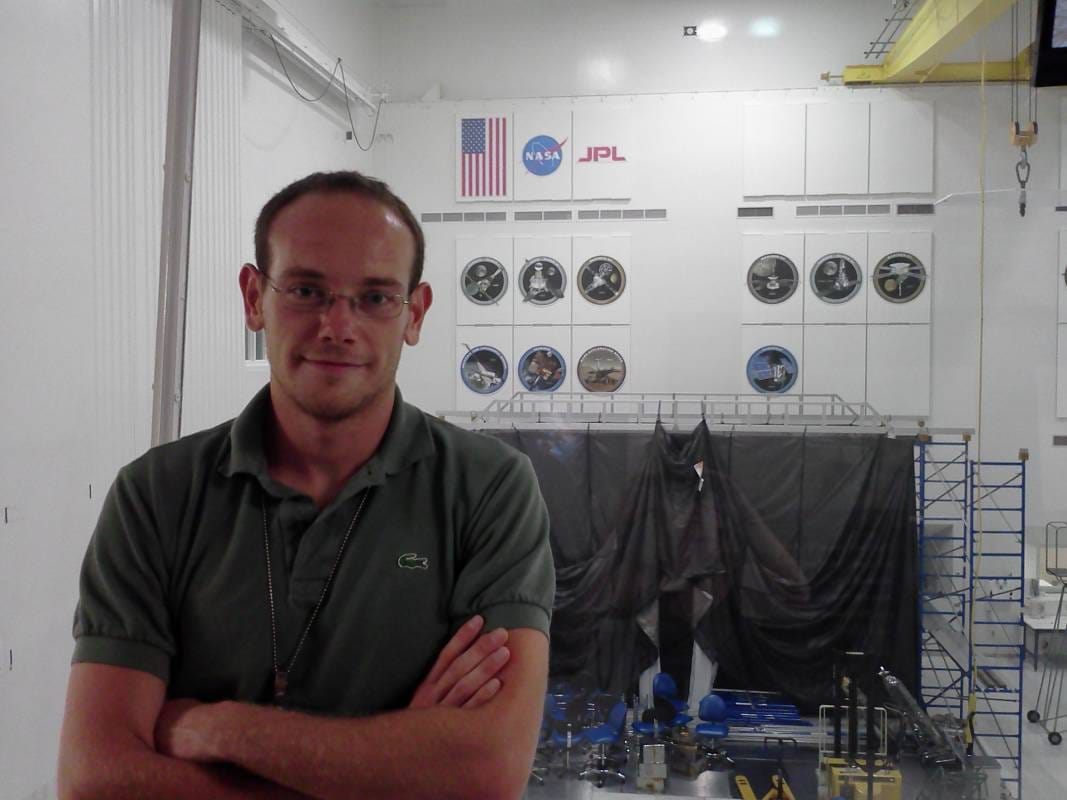
I’ve always been fascinated by black holes, however, and I knew that if I stopped studying physics to devote myself entirely to computer science, I would never understand their mystery. Back in the day, I was reading all kinds of popular science magazines on the subject… So in the end I turned to astrophysics, eventually earning a PhD degree in the field. After my first position at the Paris Observatory, I pursued a prestigious postdoctoral fellowship at NASA, free to choose my research theme. That’s how I came to focus on testing Einstein’s general relativity theory.
HM: Why did you make this particular choice? Did you have any specific goal in mind?
Olivier Minazzoli: Very importantly, from the very start Einstein himself was suggesting other alternatives to his own theory… It is still very efficient for a number of apps, like GPS, since time doesn’t flow in the same way depending on where you are. Einstein is thus behind a tool we are using on a daily basis! Certain questions remain unanswered, however. I therefore thought that by testing it, I could unearth its limitations.
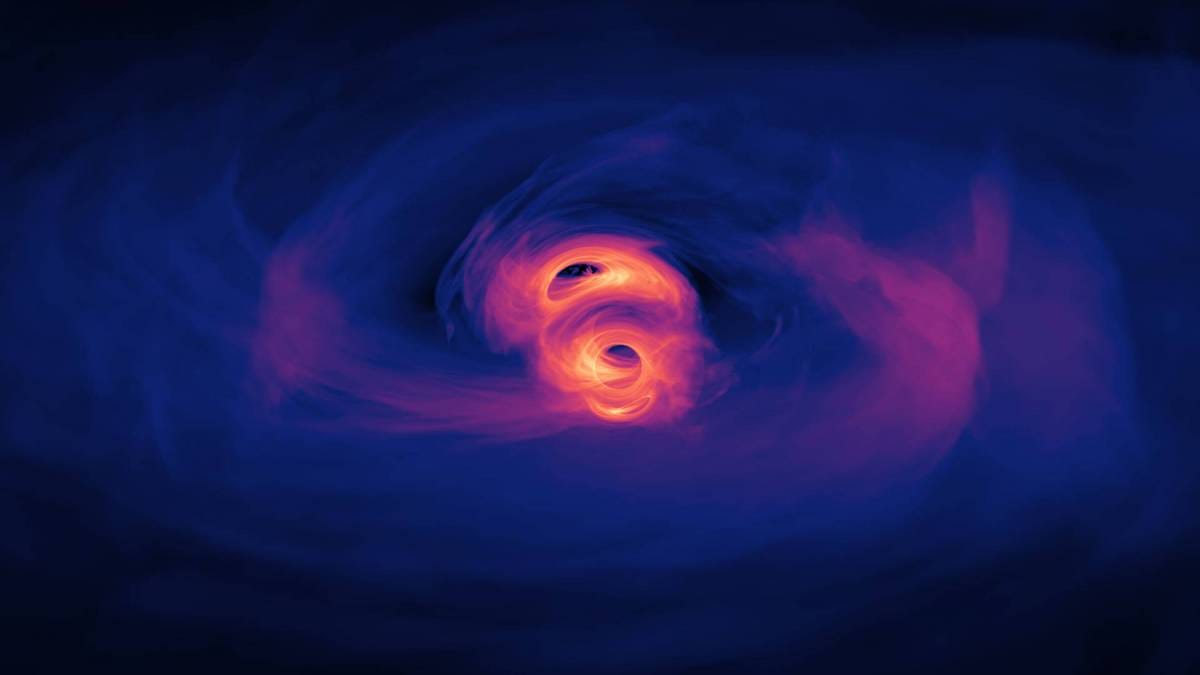
For my part, I had three good reasons to study general relativity. To start with, in physics, there is always room for improvement, the possible refining of a theory. Second, relativity as such seems to present certain theoretical problems. Due to singularities inside black holes, for example. From that point of view, the theory is incomplete.
A black hole is a star that collapses and becomes so dense that no trajectory can ever go beyond a certain limit. It is a black hole for that very reason that any object that enters it can escape it — not even light. A laser beam, for example, will be trapped inside the black hole. Another difficulty, from the general relativity perspective, is the possibility of a universe completely devoid of matter. This hypothesis violates one of the principles Einstein himself imposed when developing his theory.
And finally, there are observational constraints — those between any theory and any cosmological observations we may perform, even if the discrepancies are minimal.
In any case, this theory is believed to be very sound, providing a very accurate approximation of reality.
There are several schools of thought, however. Some believe that we could have a theory for everything; others that we would always miss something when talking about the universe.
HM: What was your conclusion from that?
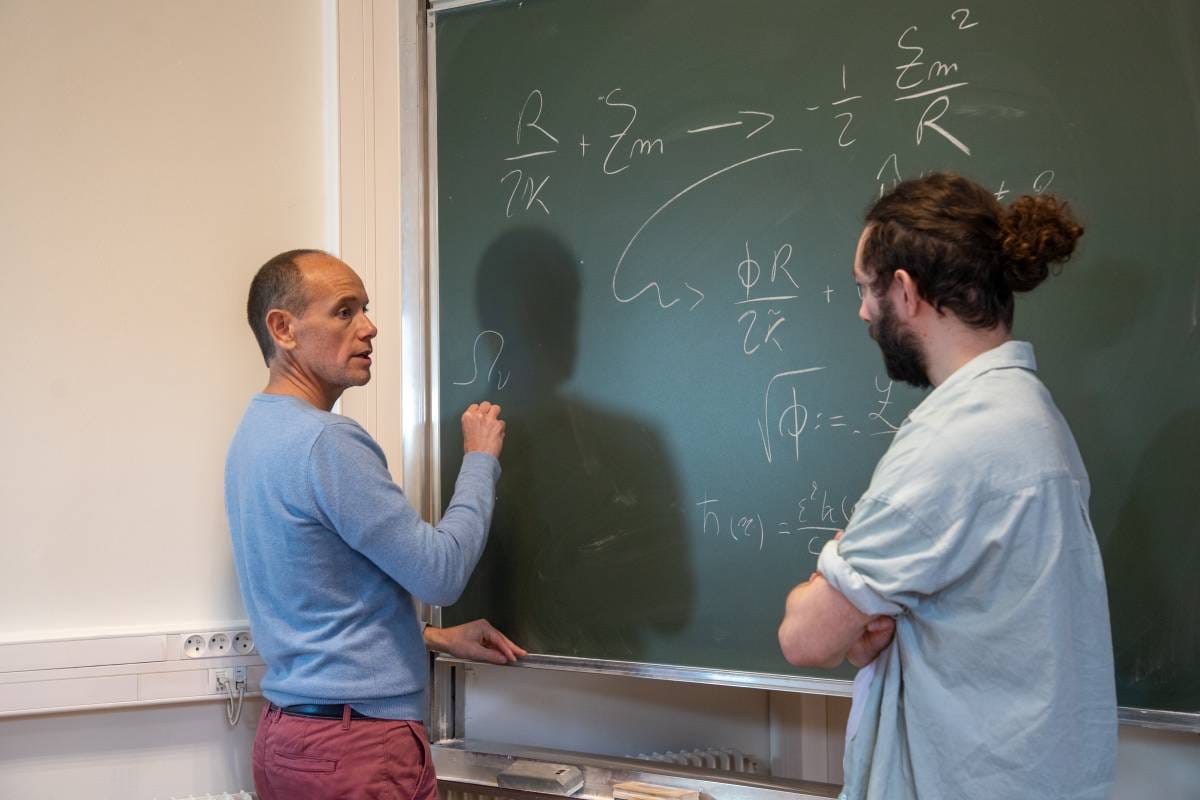
Olivier Minazzoli: I wanted to make sure that this general relativity theory is still the best compared to the other ones out there. You know, Newton’s theory was also turned out to be an approximation. Specializing in its testing, a German doctoral student, Henrik Ludwig, and myself stumbled upon the entangled relativity theory. By total serendipity! This demonstrates the importance of fostering fundamental research. We thus unexpectedly discovered that spacetime and matter cannot exist without each other; the two are closely interconnected. The universe cannot exist without matter.
Einstein started from metaphysical principles, presupposed but not confirmed experimentally. What’s wonderful is that he deduced a theory perfectly aligned with the laws of nature. That said, I would be very happy if this theory of entangled relativity one day turned out to be better than Einstein’s, but only time will tell…
HM: We can therefore affirm that artificial intelligence cannot equal humans. What do you think about it?
Olivier Minazzoli: Until a week ago, I would have conceded that. But last week, Chat GPT succeeded in producing a mathematical proof never achieved by humans. It was a geometric conjecture (Erdős) that many mathematicians, without being able to prove it, believed to be accurate. AI demonstrated, however, that it was false, thus solving an eighty-year-old mathematical problem. We have entered a new era where AI could become independent of humans, at least in terms of mathematical and physical research. Perhaps even replacing mathematicians… I don’t know how worrying that should be.
HM: AI may be competitive in calculations but it can’t observe the sky. By the way, isn’t it a bit frustrating to always be behind a screen, rarely getting to see the stars?
Olivier Minazzoli: No, not really! I do calculations, but I have infinity at my fingertips…
HM: Infinity is beyond our comprehension, but there is general curiosity about extraterrestrials. Do you think there is life on other planets?
Olivier Minazzoli: It would be infinitely unlikely for it not to. Given the colossal time and space scales of the universe (billions of years), however, the probability of having a life form nearby is infinitesimally small. We are talking about four light-years separating our planet from those outside of the solar system.
This being said, it’s possible to have primitive, elementary life nearby. On planets close enough to be detected. Mars for instance seems to be bearing traces of past life…
But planets outside of our solar system (exoplanets) are out of reach. The nearest star is at least four light-years away. The moon, for instance, which is already very difficult to reach, is just one light-second away. When we look at it first, it appears as it were a second earlier. But the further away we look, the further back in time we see. Back to the era when the universe was very young and primitive … an expanding universe that one day cooled down, became transparent and emitted the first light that we can now see through radio telescopes. Thirteen billion years ago…
HM: All this is mind-boggling… Do you believe in God?
Olivier Minazzoli: No, I don’t. From a physicist’s perspective, if god exists, his sole capacity lies in determining the laws of the universe and nature, establishing the laws of physics and initial conditions. The current consensus is reductionist: everything, such as chemistry or biology, stems originally from physics.
This god would have nothing to do with any existing dogma-based religion. I believe that all religions are mythologies… Einstein once said: “The word ‘God’ for me is nothing more than the expression and product of human weaknesses.” In physics, we are satisfied with the results we find. As the American physicist Richard Feynman puts it: “It is far more interesting to live with doubts and uncertainties than to have answers that might be wrong.”
HM: You divide your time between the Côte d’Azur Observatory and space studies in Monaco… What can you tell us about this mission?
Olivier Minazzoli: We just learned that a Monaco company is directly involved in the “Artemis” program establishing a lunar base. NASA has indeed selected the lunar rover by Venturi Astrolab, a Californian partner of this Monaco-based firm.
Furthermore, one aspect we are working on is related to environmental and ocean protection. 70% of environmental data thus comes from space. So we are very much involved in various initiatives promoting the use of space technology in terms of our oceans and resources protection.
HM: What do you think of the heatwave that hit us this summer?
Olivier Minazzoli: We just have to get used to it because it’s only going to get worse and worse.
HM: Aren’t there any solutions?
Olivier Minazzoli: Solutions there are, but they may have even more harmful repercussions. Scientists for instance proposed putting chemicals in the very upper atmosphere to reflect the sun rays and reduce the greenhouse effect. But imagine what could happen if they fell back on us… There is, however, one solution that seems more adapted. We could imagine a satellite acting as a large parasol, blocking a portion of sunlight… But I don’t know how technologically feasible that is. The best thing is to avoid generating more greenhouse gases.
HM: Do you have a dream?
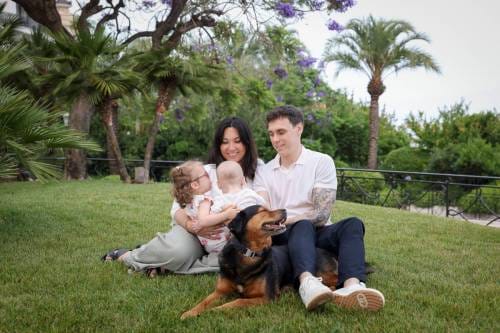
Olivier Minazzoli: I’m quite lucky in my life. I have a job I enjoy, a wife and two children, aged seven and ten. I’m perfectly happy. I was recently giving a presentation on stars and black holes to my daughter’s class at the Révoires school in Monaco. Children asked lots of questions… Otherwise, it’s true, I could have dreamed of going to space, but becoming a father made me fear for my life. I am no longer willing to take risks…